Showing posts with label Volkswagen. Show all posts

Tuesday, November 27, 2007

2007 Volkswagen GTI 5-door

2007 Volkswagen GTI 5-door - The five-door is very similar to the three-door. They have identical exterior dimensions, as well as front and rear interior volume, and, of course, the 200 horsepower jewel of an inline-four. Even curb weight is close. Our test car weighed in at 3255 pounds, only 35 more than the victorious GTI in our March 2006 comparison test. Such minor differences mean that none of the GTI’s driving pleasure is lost. The heavily bolstered and firmly cushioned seats keep the driver in place and comfortable. And the steering wheel, pedals, shifter are perfectly placed. The suspension is superbly tuned to feel sporty with minimal lean in a corner (it grips up to 0.86 g’s laterally) while still comfortably absorbing almost all bumps and jounces the wheels ride over.

Our test car came with the smooth-shifting, six-speed manual gearbox that we enjoy at least as much as the high-tech, double-clutch, paddle-shifted transmission that VW calls DSG. And despite the big torque available to the front wheels (207 pound-feet at just 1800 rpm), it’s easy to get the power down. This powertrain combination took our GTI to 60 mph in 6.4 seconds and through the quarter-mile in 15 seconds flat. And, just like the three-door, there is always enough low-end grunt to buzz by traffic around town, or pull authoritatively out of hair-pins out in the country.

So what is different? Two extra doors, in back. Those doors not only make the back seat much more accessible, but actually usable by adults. There is plenty of foot, leg, and headroom for most average size people (space was ample for your 5-foot, 11-inch author). And it’s downright cavernous for a budding family with a couple of kids.

The price of entry for VW’s sporty five-door hatch is $23,230, or $500 more than the three-door. We think that’s a bargain for more accessible space without any discernable loss in performance. As far we are concerned, this is the GTI to buy.

Monday, November 26, 2007

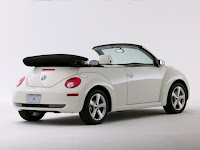
2007 Volkswagen Triple White New Beetle Convertible

2007 Volkswagen Triple White New Beetle Convertible - But we bet even reigning World’s Strongest Man Phil Pfister would be a little uncomfortable in a Triple White New Beetle Convertible; he’d likely prefer to dead-lift the car (another popular WSM event) a dozen or so times instead of actually driving it. As for describing the bug, we’re thinking of two words rhyming with “hick czar,” which, by the way, would be an apt title for Jeff Foxworthy’s autobiography.

Volkswagen’s New Beetle convertible has been garnering adoration and unnerving otherwise confident men since 2003. We have tested convertible Beetles before (in 2003 and 2004) and, despite its awesome sluggishness, the bug has managed to endear itself to us from the start. Since its last visit, though, the New Beetle has found a new engine. And this color scheme.

The three elements whose purity contributes to the “Triple White” moniker are the exterior paint, the leather interior, and the soft leather tonneau. Despite its inherent and flamboyant femininity—even above and beyond a base New Beetle convertible—we like the appearance of the Triple White package. Once the initial shock of seeing white leather seats matched with black carpeting has passed, the combination is simple and attractive, when clean.

We did not, however, seek out this bug just to see what it felt like to drive around in a white Beetle with white leather and a white tonneau. We could have guessed. We wanted to drive a Beetle with the 2.5-liter inline-five, which was introduced in 2006 and is now the only engine available in a Bug.

First surprise with the five-cylinder: torque steer. We had thought there was a minimum pound-feet requirement before a tromp on the gas peddle would jerk a car toward the weeds. Apparently that minimum requirement is 168, because that’s what the 2.5-liter inline-five has and torque steer is what it does when you poke the gas hard.

For your troubles, the VW returns an 8.8-second huff to 60 mph and a 16.7-second quarter-mile at 84 mph, meaning you’d better stop at the bleach box before trying to merge with metropolitan freeway traffic from a rest. If you really want to go 100 mph, then set aside an additional 10 seconds or so, 26.3 total. It won’t make for an exciting episode of Pinks, but it at least bested the first New Beetle convertible we tested. That car took 12.4 seconds to get to 60.

On rough roads or the winding sort, you’ll want to leave enough time to avoid hurries, as, like other entry-priced convertibles, this is not a corner bomber. Hanging onto the skidpad for 0.83 g is competent, but the car’s structural jitters when rushed over bumps suggest that this is a task best left to GTIs. The cowl shakes, the doors rattle in their openings, and we decided we could instead deal with arriving a few minutes late.

But who buys a Beetle for back-road bombing? That’s like buying one for hauling. With just five cubic feet in the trunk, a good compactor would be a wise tow-behind.

No, sir, the New Beetle is a cruiser, and very competent as a budget convertible. The high arc of the roofline means interior space is plenty big, and access to the back seat is easy. The front passenger seat requires all the force of a mouse sneeze to flip way forward, scrunching against the dashboard and leaving a cavernous passage to the rear seat. Although the back seat does suffer compared to tintop Beetles in both shoulder- and legroom, space inside for four is fair.

Of course, our Triple White model clocks in toward the higher side of “budget.” Whereas the coupe starts under $18,000 and the base price of a convertible nudges close to $23,000, the sticker on our loaded test car checked in at $26,630. That includes leather and everything else one might want on a New Beetle. Option a non-Triple White car to match and you’ll surpass that price.

With the 2008 model, the New Beetle coupe enters its tenth year on the market, putting it in the rare company of automotive old-timers to meet the decade mark. Introduced in 2003, the convertible is less aged, but it, too, is losing its head-turning ability. Once that goes, all the New Beetle is left with is decent interior space and a worn—but stylish—look for a reasonable price. It won’t help you dead-lift 700 pounds of kegs, but the New (getting Old) Beetle convertible is still pretty strong.

Friday, July 20, 2007

2006 Volkswagen Jetta GLI

2006 Volkswagen Jetta GLI - When the 2006 Jetta GLI debuted at the Detroit auto show back in January, we learned that it would arrive several months before the nearly identical fifth-generation GTI. (That car debuted in Europe at the end of 2004, but we won't get it until mid-'06.) Staffers who experienced the new GTI on European soil were impressed. The news that we'd get the GLI before the GTI was almost enough to make us look past the new Jetta's Corolla-esque styling, and the 18-inch wheels didn't hurt the looks, either. Previously, some staffers called the Jetta's styling sophisticated; these statements were not without dissent.

The tweaks that make a regular Jetta into a GLI are for the most part tasteful, restrained, and only address what is necessary to make the sweet-sorority-sister Jetta into a beer-guzzling fraternity boy. Alterations involve increasing power, firming up the chassis, and subtly differentiating the interior and exterior. How subtle? The only noteworthy exterior change is a blacked-out honeycomb grille that replaces the slatted chrome unit.

In this latest version of the GLI, Volkswagen selected the corporate 197-hp, 2.0-liter turbocharged four-cylinder engine with direct fuel injection. The cooling effect of directly injecting fuel into the combustion chamber lets VW get away with a high—for a turbocharged engine—compression ratio of 10.3:1. Compared with the previous-generation GLI's 180-hp, 1.8-liter four-cylinder, the added displacement and higher compression ratio of the new engine virtually eliminate the minor turbo lag that gave the 1.8-liter a rubber-band-like power delivery—just a small delay between hitting the pedal and getting the power.

We were curious to see if the new GLI was slower than the last of the fourth-generation GLIs. We hadn't officially tested an '05 GLI, so we rounded up a low-mileage (5537 miles) example and ran it through our battery of tests. That GLI, weighing 277 fewer pounds, turned 60 mph in 7.1 seconds and skated through the quarter-mile in 15.5 seconds at 89 mph.

The '06 GLI is larger and more refined than the fourth-generation car. When the Jetta was redesigned, it grew inside and out (especially in the back seat), material and build quality improved, and structural rigidity and isolation from the outside world increased.

It takes a lot of provocation to get the new GLI to compress its longer springs enough to meet the bump stops. What the new GLI does get is a slightly stiffened version of the strut-front and multilink-rear suspension of the base Jetta. The suspension tuning keeps the GLI more planted and, along with larger anti-roll bars, less inclined to body roll, but even with the optional 18-inch wheels ($750), there isn't much of a loss in ride comfort—17-inch wheels with 225/45R-17 summer tires are standard.

What one first notices on entering the GLI is the tilting and telescoping three-spoke multifunction steering wheel that combines the flat bottom of the Lamborghini Gallardo's with the thick and sculpted feel of the Ferrari F430's. Wrapping your paws around it elevates your mood faster than free beer. Connected to the wheel is VW's electrically assisted rack-and-pinion steering that does a convincing impersonation of hydraulic power assist. On-center feel seems better than that of the base car and makes triple-digit speeds stress-free. Turn-in is predictable.

Our tester had comfortable and supportive optional leather seats that were part of a $3200 package that bundles dual-zone climate control, heated front seats, a sunroof, satellite radio, and radio and trip- computer controls on the steering wheel. À la carte options include rear side-impact airbags ($350) and the 18-inch wheels and tires.

It might sport that badge, but the rest of the vehicle constantly whispers Audi, so much so that this newest GLI bears almost no relation to the previous GLI. This successor is chasing after $25,000-to-$30,000 sports sedans, and if you're shopping in that class, the GLI is a viable alternative. However, many of us will miss the cheeky nature of the previous GLI.

Thursday, July 5, 2007

Volkswagen Passat 3.6

Volkswagen Passat 3.6 - A little mitigation: The big bottom line on our test car's window sticker included the $5550 Package #2 Sport. We're mystified by this, since most of the elements baked into the package—HID headlights, headlight washers, park warning radar, and a super-premium audio upgrade—have nothing to do with sport.

We mentioned bigger. The wheelbase stretch is negligible, 106.7 inches versus 106.4; but overall length is up 3.0 inches, to 188.2; width has expanded by an equal amount to 71.7; and at 58.0 inches the new car is almost a half-inch taller. Although these dimensional gains yield a car that's about the same size as a Honda Accord or Toyota Camry, they do add up to a roomier Passat. And inevitably, it adds up to a slightly heavier one.

Which brings us to what's going on under the hood. The short version: more than enough to overcome a little excess mass. VW's new premium Passat engine is a 3.6-liter, 24-valve V-6, replacing the old 2.8-liter V-6 from Audi and the ill-starred 4.0-liter W-8, a technically interesting innovation that tanked in the marketplace. Never mind. The new V-6 will make you forget the W-8, were you inclined to remember it.

The engine sits crossways in its bay—the previous Passat had a longitudinal layout—and it transmits power to the front wheels via a six-speed automatic transmission that includes a Tiptronic paddle-shift manumatic function. We'd rate the action of the Tiptronic as average—manual shifts are deliberate, and the transmission's brain will upshift on its own rather than let the engine bounce off the rev limiter. We'd also call the engine a little too snarly at low speeds, although it does acquire a commanding bark when max power is summoned.

This also extends to the Passat's dynamics. Although it's hefty, with a typical front-drive forward weight bias—much of the engine's mass rides ahead of the front-axle center line—the Passat is also handier than its more sedate competitors when the pavement gets kinky. The suspension is familiar—struts with lower control arms holding up the front, and a multilink rear—and the tuning, augmented by that stern, Teutonic structure, delivers a sense of authority and certainty that still seems to be unique to cars with autobahn heritage.

Premium accurately describes the Passat's appearance, inside and out. Although some of our Hogback Luddites prefer the simpler look of the previous edition, the new car's sculpted sheetmetal generates a more upscale impression than that of its slab-sided predecessor. Yes, the bigger, bolder grille and logo are reminiscent of the Phaeton—another idea VW's current management would love to be able to forget—but it does reinforce the luxury theme. And if the going-away view looks a lot like a Toyota Corolla, well, when you're terrorizing back roads, you won't have to look at it.

We can't gin up much enthusiasm for the new key-fob ignition lock. You push the fob all the way into the spring-loaded dashboard slot until the car starts, and like all such devices, we're not quite clear on its benefit. But that's where the market is headed, and at least this fob will open the sunroof and/or windows as you head across the parking lot. We also have trouble getting excited about the refrigerated glove box, but it's a big refrigerated glove box, in case you need to stash a leftover rack of ribs.

But for all that, we think the Passat may face an uphill fight for its place in the U.S. mid-size-sedan market. Beyond the noise and suspension-clatter issues, there's that price. The least expensive Passat—VW calls it the Value Edition (read "decontented"), with a 197-hp, 2.0-liter turbo four and six-speed manual transmission—starts at $23,565. That's only about two grand less than a Honda Accord LX with a V-6.

Thanks to the highest production costs of any European carmaker, and the strength of the euro, VW, long the people's car company, is forced to position its offerings at the premium end of their respective segments.
eXTReMe Tracker